

A good solution starts with understanding the right problem. A team may spend months building a product that works as intended, only to discover that it does not address what users actually need. Design thinking helps teams avoid this by putting people and their problems at the centre of the problem-solving process.
Design thinking is a human-centered approach to solving problems by understanding users, exploring ideas, testing solutions, and improving them based on feedback. It is commonly explained through five stages: empathize, define, ideate, prototype, and test.
What is Design Thinking?

Design thinking is a problem-solving approach that helps teams understand people, identify the problems they face, and develop solutions around those needs. Instead of starting with a solution and trying to make it work, teams first explore the problem and the people experiencing it.
The approach is widely used in UX and product design, but it can also be applied to services, business processes, and other complex problems.
Design thinking meaning in simple words
In simple terms, design thinking means understanding the problem from the user’s point of view before deciding what to build.
For example, if users are abandoning a mobile banking app while making payments, a team should first understand why this happens. Is the payment option difficult to find? Is the process confusing? Are users unsure whether the transaction went through?
These questions help teams move beyond assumptions and work towards a solution based on actual user needs.
What problems does design thinking solve?
Design thinking is useful when the problem is unclear, involves different user needs, or has several possible solutions. It helps teams:
- Understand user needs and pain points
- Identify the underlying problem
- Challenge assumptions
- Explore multiple solutions
- Test ideas before investing heavily in development
- Improve products and experiences based on feedback
Why is Design Thinking Important?
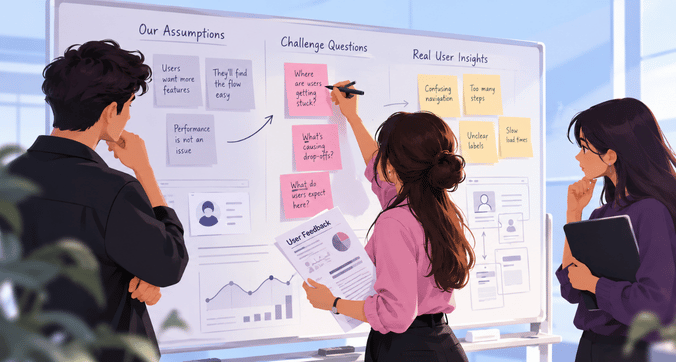
Design thinking helps teams make decisions with a clearer understanding of the people they are designing for. User research can reveal problems that may not be visible from internal discussions or business requirements alone.
It also creates room for experimentation. Instead of committing to one solution immediately, teams can explore several ideas and create prototypes to see what works.
For product and UX teams, this can lead to more usable experiences and help identify problems earlier in the design process. It also creates a shared way for designers, developers, product managers, and business teams to discuss user problems and potential solutions.
What Are The 5 Stages of Design Thinking?
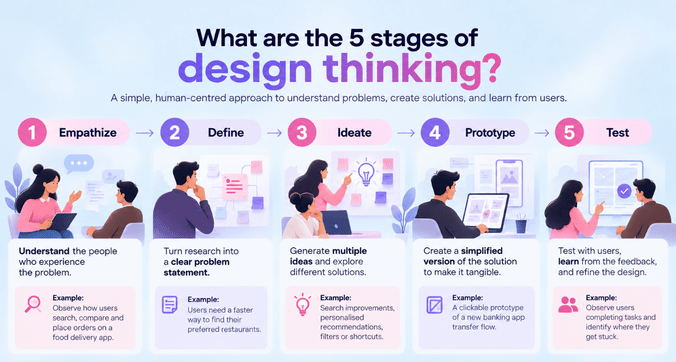
The five stages of design thinking are empathize, define, ideate, prototype, and test. They provide a framework for understanding a problem, exploring solutions, and learning from users.
Stage 1 – Empathize
The first stage is about understanding the people who experience the problem. The team gathers information about their needs, behaviours, goals, and frustrations.
Common methods include:
- User interviews
- Surveys
- Observation
- Usability research
- Reviewing existing user feedback
For example, a team redesigning a food delivery app may observe how users search for restaurants, compare options, and place an order. The goal is to understand what users actually do rather than relying only on what the team assumes they do.
Stage 2 – Define
Once research is collected, the team organizes the findings and identifies the main problem that needs to be addressed.
This stage turns a collection of observations into a clear problem statement. For example:
Users need a faster way to find their preferred restaurants because searching through multiple categories makes the ordering process longer.
A clear problem statement gives the team a direction for the next stages.
Stage 3 – Ideate
The ideation stage is where teams explore possible solutions. Rather than choosing the first idea that seems workable, they generate multiple possibilities.
Brainstorming, sketching, workshops, and other collaborative activities can help teams explore different approaches.
For example, a team might consider search improvements, personalised recommendations, saved restaurants, filters, or shortcuts.
The goal is to create enough options to explore before deciding which ideas are worth developing further.
Stage 4 – Prototype
A prototype is a simplified version of a proposed solution. It allows teams to make an idea tangible without building the complete product.
Depending on the project, a prototype could be:
- A paper sketch
- A wireframe
- A clickable interface
- A mockup
- An interactive product flow
For example, a UX team could create a clickable prototype of a new banking app transfer flow instead of developing the complete feature.
Stage 5 – Test
The prototype is tested with users to understand how well it addresses the problem.
Teams may observe users completing specific tasks, ask questions, and identify points where users become confused or stuck. The findings can then be used to improve the design.
Testing does not simply confirm whether an idea works. It can also reveal new problems that send the team back to an earlier stage.
Is Design Thinking Process Always Linear?

No. Design thinking is better understood as an iterative process than a fixed sequence.
For example, testing a prototype may reveal that the team misunderstood the user’s original problem. The team may then return to the define or empathize stage and conduct more research.
Similarly, ideation may reveal that the original problem statement needs to be reconsidered.
The five stages provide structure, but teams can move between them as they learn more.
Simple Design Thinking Example

Improving a mobile banking app
Imagine that users frequently struggle to transfer money through a mobile banking app.
Empathize: The team interviews users and observes how they currently make transfers. They find that many users have difficulty locating the transfer option.
Define: The team identifies the problem: users need a faster and clearer way to start a money transfer.
Ideate: The team explores different solutions, such as a shortcut on the home screen, improved navigation, and a simpler transfer flow.
Prototype: Designers create a clickable prototype of the new transfer experience.
Test: Users are asked to complete a transfer using the prototype. The team observes where they hesitate or make mistakes and collects their feedback.
The team can then refine the design based on what it learns. If testing reveals a different issue, it can return to an earlier stage and investigate further.
Where Is Design Thinking Used?

Design thinking can be used wherever teams need to solve problems involving people and their experiences. Common applications include:
- UI/UX design
- Product design
- SaaS products
- Enterprise applications
- Mobile apps
- Service design
- Business process improvement
For example, an enterprise software team may use design thinking to understand why employees struggle with an internal tool, while a mobile product team may use it to improve a particular user journey.
Design Thinking vs Traditional Problem Solving
| Design thinking | Traditional approach |
| Starts by understanding users | May start with an internally defined problem |
| Tests assumptions through research and feedback | May rely more heavily on existing assumptions |
| Encourages iteration | Can follow a more linear process |
| Uses prototypes to explore ideas | May develop a more complete solution before testing |
| Uses user feedback throughout the process | Feedback may come later in the process |
This does not mean traditional problem-solving methods are unsuitable. The difference is that design thinking puts greater emphasis on understanding users, exploring alternatives, and learning through iteration.
Common Mistakes in Design Thinking

Design thinking can lose its value when teams treat it as a checklist rather than a way of working. Some common mistakes include:
- Starting with a solution: Deciding what to build before understanding the problem can lead to solutions that address the wrong need.
- Skipping research: Without user input, teams may base decisions on assumptions.
- Testing only internally: Team members already understand the product, so their feedback may not reflect how new users experience it.
- Falling in love with the first idea: The first workable idea is not necessarily the best one to explore.
- Treating the five stages as rigid: Teams may need to revisit research or redefine the problem as they learn more.
How f1Studioz Uses Design Thinking In UX Projects
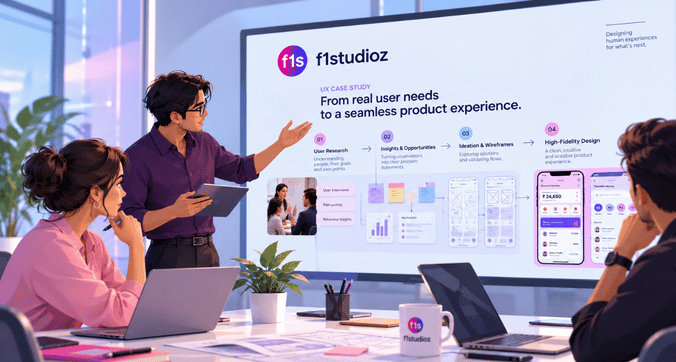
At F1 Studioz, design thinking can be applied as part of a broader UX and product design process. The work begins by understanding the user’s needs alongside the business and product context.
Teams can use UX research to identify pain points, map user journeys to understand where problems occur, and explore different approaches before settling on a solution. Prototypes then make these ideas easier to evaluate and test.
Feedback from testing helps refine the experience before the final design moves further into development. This connects design decisions with actual user behaviour and the broader product goals.
Frequently asked questions
What is design thinking in simple words?
Design thinking is a human-centered approach to problem solving. It involves understanding users, defining their problems, exploring solutions, creating prototypes, and testing them with users.
What are the five stages of design thinking?
The five stages are empathize, define, ideate, prototype, and test.
Why is design thinking important?
Design thinking helps teams understand real user problems, challenge assumptions, explore different ideas, and test solutions before committing to a final approach.
Is design thinking only used in UX design?
No. It is used in product design, service design, business processes, SaaS products, enterprise applications, and other areas where teams need to solve problems involving people.
What is an example of design thinking?
Improving a mobile banking transfer experience is one example. A team could research user difficulties, define the problem, explore solutions, prototype a new flow, and test it with users.
Is design thinking a linear process?
No. Teams can move between stages as they learn more. For example, testing can reveal a new problem that requires additional research or a revised problem statement.
Final Thoughts
Design thinking provides a structured way to solve problems by starting with people and learning through the process. Its five stages — empathize, define, ideate, prototype, and test — help teams move from understanding a problem to exploring and improving potential solutions.
For businesses building digital products, this approach can help create experiences that are grounded in real user needs.
If you are looking to improve a digital product or create a more user-focused experience, explore f1Studioz’s UI/UX design services.