In a world of Zoom calls, Figma files, and Slack threads, does it really matter if your UI/UX agency sits in Bangalore while you’re based in Delhi? Surprisingly, it does, but not for the reasons you might expect.
If you’re reading this, chances are you’re searching for an agency and feeling overwhelmed by the sheer number of choices. Does a Bangalore studio bring something different to the table compared to one in Mumbai? Do costs vary meaningfully from city to city? And with everyone working remotely anyway, does geography even influence the quality of your project?
This guide breaks it all down. We’ll look at what makes each city’s design ecosystem unique – the talent, the culture, the specializations, the pricing – so you can make an informed decision. By the end, you’ll see that choosing the right agency isn’t about distance. It’s about finding the partner whose expertise aligns with your specific needs.
The Big Question: Does Location Really Matter in 2025?
Let’s address this head-on because it’s the question on everyone’s mind.
When Location Doesn’t Matter: The “Remote 90%”
For 90% of the day-to-day work, location is completely irrelevant. Designing in Figma, collaborating on Slack, conducting weekly check-ins, sharing prototypes, iterating on designs – all of this happens seamlessly in the cloud. The best talent can be anywhere, and the tools we use today have eliminated most geographical barriers.
Your designer in Hyderabad can share a clickable prototype just as quickly as one sitting across the table from you. Code handoffs, design systems, and even client presentations all happen in digital spaces that work equally well whether your team is 5 kilometers or 500 kilometers away.
When Location Does Matter: The “Onsite 10%”
There are high-value moments where being in the same room creates real, tangible benefits. In-person kick-off workshops help build rapport and alignment in ways that video calls can’t quite replicate. Deep-dive strategy sessions benefit from the energy of whiteboarding together. Crucial usability testing, especially with specific user groups, can be more effective when conducted face-to-face.
These moments represent maybe 10% of the project timeline, but they can account for 30% of the value. If your budget and timeline allow, consider flying to your agency for these pivotal sessions, or bringing them to you.
The “Ecosystem” Factor (The Real Reason to Choose a City)
Here’s the real reason location matters, and it’s not about time zones or travel costs. It’s about the ecosystem.
An agency in Bangalore breathes SaaS and B2B tech every day. They’re surrounded by product managers, startup founders, and VCs. They’ve likely designed dashboards for 20 other B2B companies, so they know what works and what doesn’t.
An agency in Mumbai is immersed in D2C brands, media companies, and high-polish creative campaigns. They understand consumer behavior, brand storytelling, and the e-commerce funnel in their bones.
You’re not just hiring an agency’s team – you’re hiring their collective experience, their network, and the expertise they’ve absorbed from their city’s dominant industries. That’s the ecosystem advantage.
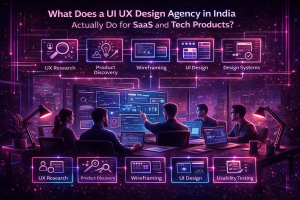
If you’re still unsure what a UI/UX agency actually handles from research to usability testing, here’s a detailed breakdown of what a UI/UX design agency does.
A Tour of India’s Top UI/UX Design Hubs
Let’s explore the “personality” of each major hub to help you understand where to begin your search.
Bangalore (The “Silicon Valley of India”)
The Vibe: Tech-first, product-obsessed, fast-paced, deeply integrated with the startup and VC ecosystem. Conversations naturally drift toward user retention, activation metrics, and product-market fit.
Specialization: B2B & SaaS platforms, FinTech applications, complex product design, HealthTech solutions. Agencies here speak the language of product managers. They understand enterprise sales cycles, freemium models, and the nuances of designing for power users versus casual users.
Cost: Generally the highest in India, as demand for top-tier talent is fierce. Senior designers and researchers command premium rates here because everyone from startups to multinational corporations is competing for the same talent pool.
Best For: If you’re building a SaaS product, a B2B platform, or a complex enterprise application, Bangalore agencies have seen your challenges before and know how to solve them.
Mumbai (The “Creative & Financial Capital”)
The Vibe: Brand-led, high-polish, creative, with a strong connection to media, advertising, and consumer brands. Design here often considers not just usability but storytelling, emotion, and brand perception.
Specialization: Direct-to-Consumer (D2C) e-commerce, media and entertainment platforms, consumer FinTech apps, and high-end corporate branding. Mumbai agencies excel at creating experiences that feel premium and that drive consumer conversion.
Cost: High, often on par with Bangalore, especially for agencies with strong branding and advertising backgrounds. You’re paying for creative excellence and brand expertise alongside UX skills.
Best For: If you’re launching a D2C brand, building a consumer-facing app, or need to combine brand strategy with UX design, Mumbai agencies bring that unique creative-meets-commercial perspective.
Delhi NCR (Noida/Gurgaon) (The “Enterprise & Corporate Hub”)
The Vibe: Corporate, process-driven, structured. Home to many of India’s largest enterprises, consulting firms, and multinational headquarters. There’s an emphasis on scalability, governance, and working within established corporate frameworks.
Specialization: Large-scale enterprise applications, B2B portals, government and public sector projects, real estate tech, automotive, and corporate intranets. Agencies here understand stakeholder management, lengthy approval processes, and designing for complex organizational hierarchies.
Cost: Can be slightly more competitive than Bangalore or Mumbai, though top-tier agencies still command premium rates. The market is large and diverse, so you’ll find a wide range of pricing.
Best For: If you’re a large enterprise needing a B2B portal, working on a government project, or require an agency comfortable navigating corporate structures and compliance requirements, Delhi NCR is your hub.
Hyderabad (The “Emerging Tech Powerhouse”)
The Vibe: Growing rapidly with a strong tech and R&D focus, thanks to major campuses from Microsoft, Google, and Amazon. It feels like Bangalore did 10 years ago – hungry, ambitious, with excellent technical talent but slightly lower cost pressures.
Specialization: Enterprise tech solutions, PharmaTech, HealthTech, and complex B2B platforms. The city’s pharmaceutical and life sciences industry also creates unique expertise in highly regulated, compliance-heavy design.
Cost: Generally offers a “cost-to-quality” advantage over Bangalore. You can access excellent talent at more competitive rates, though the ecosystem is less saturated, meaning you’ll have fewer agencies to choose from.
Best For: If you need tech expertise, particularly in enterprise or healthcare domains, and want to optimize for both quality and budget, Hyderabad is an excellent choice.
Don’t Forget the Rising Stars: Pune & Chennai
Pune has a strong B2B, automotive, and engineering software ecosystem. With many global engineering centers and automotive OEMs based here, agencies in Pune excel at industrial design, complex data visualization, and B2B tools.
Chennai is emerging as a hub for SaaS and enterprise software, with a growing community of talented designers who often offer excellent value. The city also has deep cultural expertise for Tamil-speaking markets.
Both cities offer great talent at competitive price points and are worth considering if your industry aligns with their strengths.
How to Choose: A Simple Decision Framework

Stop thinking about geography first. Instead, think about your business needs, then use location as a filter.
Choose Based on Your Business, Not Your City
- If you’re a SaaS startup or building a B2B platform: Start your search in Bangalore or Pune. Look for agencies with portfolios heavy on dashboards, complex workflows, and enterprise products.
- If you’re a D2C e-commerce brand or consumer app: Start your search in Mumbai. Look for agencies that combine brand thinking with conversion optimization.
- If you’re a large enterprise needing a B2B portal or enterprise application: Start your search in Delhi NCR or Hyderabad. Look for agencies experienced in stakeholder management and corporate environments.
- If you’re on a tighter budget but still need strong tech expertise: Look at Hyderabad or Pune. Don’t compromise on quality, but leverage the cost advantages these emerging hubs offer.
- If you need deep cultural or linguistic expertise for regional markets: Consider agencies in cities where that language is spoken. A Chennai agency for Tamil markets, an Ahmedabad agency for Gujarati markets, etc.
How to Evaluate an Agency (Whether They’re Remote or Local)

Here’s the truth: the city just helps you create a longlist. To narrow it down to your final choice, your evaluation process should be identical whether the agency is next door or across the country.
Your Evaluation Checklist is the Same
You still need to judge their portfolio rigorously. Do they have relevant case studies? Can they demonstrate measurable impact? You still need to understand their process. How do they conduct research? What does their iteration cycle look like? You still need to meet their people. Will you enjoy working with them? Do they ask good questions?
The city tells you where to start looking. Your scorecard tells you who to hire.
Here’s a structured framework to help you evaluate and shortlist UI/UX agencies with clarity and confidence.
For a detailed framework on evaluating agencies – including the specific questions to ask and red flags to watch for – you’ll want a structured approach that works regardless of location.
If you want a complete step-by-step roadmap for hiring the right partner, read our ultimate guide to hiring a UI/UX design agency in India.
Conclusion

Stop looking for the “best city for UI/UX.” Start looking for the “best agency for your problem.”
In 2025, an agency’s location is just one small data point. Their process, their portfolio, and their people are what will truly determine the success of your project. Yes, ecosystem matters – a Bangalore agency will have different collective experience than a Mumbai one – but that’s about industry expertise, not about whether they’re nearby.
The best agency isn’t the one down the street. It’s the one that understands your user.
Whether they’re remote or local, what matters is their ability to solve your specific design challenges, their communication process, and their track record of delivering results. Use location as a starting filter, then evaluate rigorously based on capabilities.
We’re a remote-first agency with team members across India. See how our process delivers results, no matter your location.
FAQs
Which city is best for UI/UX agencies in India?
There is no “best” city, only a “best fit” for your specific needs. Bangalore is the best for SaaS products and B2B platforms. Mumbai is the best for creative D2C brands and consumer apps. Delhi NCR excels at enterprise solutions. Hyderabad offers excellent tech expertise at competitive rates. Start by identifying your industry and product type, then look at the city that specializes in it.
Are agencies in Bangalore more expensive than in Noida (Delhi NCR)?
Generally, yes. Bangalore agencies often have higher costs due to intense competition for senior talent, which gets reflected in their rates. However, top-tier agencies in Noida and Gurgaon are also premium-priced. The difference might be 10-20% rather than 50-100%. Don’t let cost be the only factor – the wrong agency at a lower price will cost you far more in the long run.
For a detailed breakdown of pricing models and real 2025 cost ranges across agency tiers, see our complete UI/UX design cost guide.
Can I hire an agency remotely if I’m in a smaller city?
Absolutely! This is the new normal. The most important thing is to find an agency with a fantastic remote communication process. Ask them specific questions: “How do you manage remote client workshops?” “What tools do you use for collaboration?” “How often will we have face-time?” A confident, detailed answer is a sign of a great remote partner. A vague answer is a red flag.
Are there good UI/UX agencies in Tier 2 cities?
Yes, absolutely. Cities like Ahmedabad, Kochi, Chandigarh, and Jaipur have growing and talented design communities. These agencies often offer an excellent cost-to-quality ratio. The main difference is the ecosystem – they may have less exposure to large-scale SaaS or cutting-edge FinTech compared to Bangalore, but this gap is closing fast. Many designers from top hubs are returning to Tier 2 cities, bringing that expertise with them.
Is language (e.g., Hindi, Tamil) a factor when choosing an agency?
It can be, especially if your product is for a specific non-English speaking audience. An agency in Chennai, for example, might have a deeper cultural understanding for designing a Tamil-language app. They’ll know the nuances, idioms, and cultural contexts that a team unfamiliar with the language might miss. However, most top agencies in any hub have experience conducting user research in multiple Indian languages and can bring in specialist researchers when needed.
What’s the real advantage of a “hub” city if my business is also remote?
The advantage is the agency’s collective experience. An agency in Bangalore has likely worked on 20 other SaaS products. They’ve seen what onboarding flows fail and which dashboard layouts succeed. An agency in Mumbai has probably designed 15 D2C e-commerce experiences and knows exactly how Indian consumers behave on mobile. You’re hiring that ecosystem knowledge – the pattern recognition that comes from repeated exposure to similar challenges. That’s valuable whether you meet in person or not.