
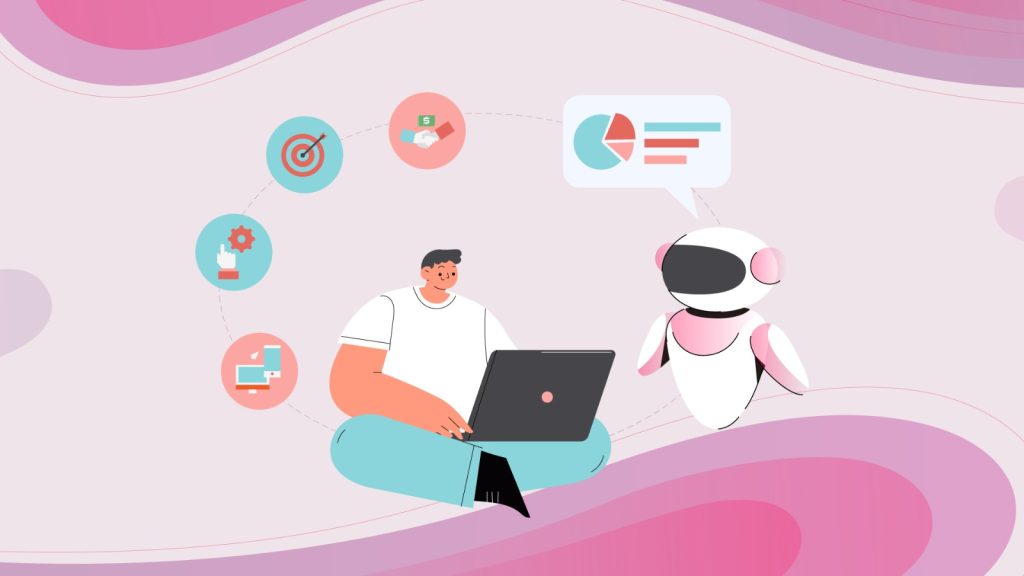
Revolutionizing SaaS: The Impact of AI on User Experience
Artificial intelligence has stirred up a storm ever since it entered the digital world. It has revolutionized almost every industry, from healthcare and e-commerce to banking and media & entertainment. The same is true for the SaaS industry.
AI has transformed SaaS applications through machine learning, automation, predictive analytics, and enhanced data analysis. When thoughtfully implemented, these technologies can help businesses create more personalized, efficient, and intuitive digital experiences.
According to reports, the AI in SaaS market is expected to experience significant growth in the coming years. For SaaS businesses, this makes understanding the relationship between AI and user experience increasingly important.
AI should not be added simply because it is trending. Its real value comes from solving genuine user problems, reducing friction, and helping users accomplish their goals more efficiently.
In this blog, we’ll explore the different ways AI can elevate user experience in SaaS applications and the important considerations businesses should keep in mind.
Unlock Exceptional User Experience for Your SaaS App Using AI
Here is how you can leverage AI to create a smarter and more user-friendly SaaS experience.
Predictive Modeling
Predictive modeling is one of the most useful applications of AI for enhancing user experience.
AI can study and analyze large amounts of user data to identify patterns and predict how users may interact with your SaaS application.
This allows SaaS platforms to anticipate user needs and present relevant information or features before users even realize they need them.
For example, if a user frequently accesses a particular report, the platform could make that report easier to find or recommend it at the right time.
This type of predictive UX can reduce unnecessary navigation and help users reach relevant information faster.
It can also help SaaS companies identify users who may be struggling with a product or showing signs of disengagement, allowing teams to provide assistance at the right moment.
This approach is closely connected to UX for AI, where artificial intelligence is designed around user needs while maintaining transparency, trust, and control.
Personalized Experience
No user dislikes an experience tailored to their needs.
Personalized recommendations, offers, content, and workflows can make a SaaS product more relevant and useful.
AI can study factors such as:
- User interactions
- Feature usage
- Browsing behavior
- User preferences
- Previous activity
- Engagement patterns
- User roles
Based on these signals, a SaaS platform can adapt parts of the experience to individual users.
For example, a new user may receive onboarding guidance, while an experienced user may see shortcuts to advanced features.
Netflix is a familiar example of personalization. Its recommendation system uses user behavior and preferences to suggest relevant content.
The objective is not to personalize every part of the interface. Instead, AI should provide relevant personalization at the right moment without making the product feel unpredictable.
For SaaS businesses, these improvements can also support conversion and retention. A strong UX strategy for SaaS conversion and retention can help turn better user experiences into measurable business outcomes.

AI-Driven Assistance
If you want to answer user questions and provide assistance quickly, AI can become a valuable part of the SaaS experience.
AI-powered assistants can help users:
- Find information
- Understand product features
- Troubleshoot common problems
- Navigate workflows
- Summarize information
- Generate content
- Answer product-related questions
This can reduce the amount of time users spend searching through documentation or contacting customer support.
According to industry research, many users appreciate the speed and convenience offered by chatbots and virtual assistants.
For SaaS products, this can be taken further through conversational UI.
Instead of navigating through several menus, users can communicate with the product using natural language.
However, conversational AI works best when it is connected to reliable product information and has clear boundaries around what it can and cannot do.
For complex issues, users should also have an easy way to connect with human support.
Automation
AI can save users significant time by automating repetitive and time-consuming tasks.
Common examples include:
- Data entry
- Email drafting
- Content generation
- Data categorization
- Report summaries
- Meeting summaries
- Document processing
- Workflow automation
This allows users to spend more time on activities that require creativity, judgment, and decision-making.
The goal should not simply be to automate as many tasks as possible.
Instead, businesses should identify repetitive activities that create unnecessary effort and determine where automation can provide genuine value.
AI can also contribute to front-end development by helping teams automate repetitive development tasks and build more efficient digital experiences.
Intuitive Interface
AI can enhance different aspects of a SaaS application and contribute to a more intuitive interface.
Predictive recommendations can reduce navigation effort, personalization can make content more relevant, and natural language interfaces can simplify complex interactions.
AI’s natural language processing can make SaaS interfaces more conversational, allowing users to interact with applications more naturally.
AI can also help product teams understand how users interact with different parts of the interface.
By analyzing behavioral patterns, teams can identify:
- Frequently used features
- Abandoned workflows
- Navigation problems
- Repeated errors
- Underused features
- Common user questions
These insights can then inform UX improvements.
AI should therefore not only power the interface; it can also help teams understand how the interface should evolve.
As SaaS products grow, maintaining consistency across screens and features also becomes important. A scalable design system can help teams maintain consistent UI patterns while introducing new AI-powered features.
AI-powered experiences should also work smoothly across different devices, making responsive SaaS interfaces an important part of the overall product experience.
Level Up Your SaaS App With f1Studioz!
We at F1Studioz are focused on creating user-centered digital experiences for SaaS and technology-driven businesses.
With expertise across UX research, product strategy, UI/UX design, interaction design, and front-end development, our team helps businesses create digital products that are easier to use and aligned with real user needs.
Our SaaS UI/UX design services are focused on creating intuitive experiences that balance business objectives with user expectations.
You can also explore our work and case studies to see examples of digital experiences created for businesses across industries.
Conclusion
AI is not just a new trend. It is becoming an important part of how modern SaaS products are designed, developed, and experienced.
From predictive modeling and personalization to conversational interfaces, automation, intelligent search, accessibility, and behavioral analytics, AI can improve different stages of the SaaS user journey.
But successful AI-powered UX is not about adding the maximum number of AI features.
It is about identifying real user problems and using AI to solve them in a way that is useful, transparent, secure, and easy to understand.
The SaaS products that get this balance right can create experiences that are more personalized, efficient, accessible, and valuable for their users.

Without Losing the Human Touch.