
Predictive AI analyzes historical data to forecast outcomes, while generative AI creates new content from patterns learned during training. Both types reshape how product teams design experiences, automate workflows, and deliver value, but they serve fundamentally different purposes in enterprise applications and SaaS platforms. Choosing the right model type determines whether your product anticipates or creates.
What Separates Predictive AI from Generative AI
These two AI paradigms operate on different objectives: one forecasts, the other produces. Understanding this distinction is foundational for product leaders and enterprise decision-makers evaluating AI investments in 2025 and beyond.
Predictive AI uses structured datasets, statistical models, and machine learning algorithms to identify patterns and forecast future behavior. It answers the question: What will happen next? Common implementations include churn prediction in SaaS platforms, fraud detection in financial products, and personalized recommendation engines in e-commerce.
Generative AI, by contrast, learns from vast unstructured data, such as text, images, code, and audio, and produces entirely new outputs. It answers: What can we create? Practical deployments include AI-generated content systems, design asset generation, intelligent chatbots, and code synthesis tools that reduce developer overhead.
Predictive AI
Forecasts based on historical patterns. Best for analytics, behavioral modeling, risk scoring, and demand planning.
Generative AI
Creates new outputs from learned patterns. Best for content generation, design, code synthesis, and conversational interfaces.
| Feature | Predictive AI | Generative AI |
| Primary Function | Forecast outcomes from data | Create new content or outputs |
| Data Type | Structured, labeled datasets | Unstructured text, images, code |
| Output | Probability scores, predictions | Generated text, media, or code |
| Key Models | Regression, classification, neural nets | LLMs, diffusion models, GANs |
| Product Use Case | Churn prediction, fraud detection, ranking | Copilots, content tools, chatbots |
| UX Impact | Proactive personalization, smart nudges | AI-assisted creation, adaptive interfaces |
| Interpretability | Higher outputs are explainable | Lower — probabilistic generation |
Real-World Use Cases Across Enterprise and SaaS
Both AI paradigms have clearly defined production use cases. The most effective enterprise implementations combine them using predictive intelligence to inform when and how generative AI activates within a user journey.
Predictive AI in Product Experiences
Predictive analytics systems power many of the invisible intelligence layers in modern digital products. When a CRM surfaces a lead score, when a streaming platform queues the next show, or when a banking app flags an unusual transaction, predictive models are operating behind the interface.
For SaaS founders and product teams, predictive AI drives behavioral analytics, enabling smarter segmentation, proactive in-app messaging, and conversion-focused UX that responds to user intent before users articulate it. This creates compounding retention value, a metric that directly affects ARR and lifetime customer value.
Product teams evaluating AI-driven experiences often also explore How the Design Thinking Process Helps Solve Real User Problems before building predictive personalization into their user flows because the methodology reveals where prediction adds the most friction-reducing value.
Generative AI in Product Workflows
Generative AI applications have moved from experimental to production across content-heavy and developer-facing products. AI-generated content systems are embedded in marketing platforms, design tools like Figma plugins, enterprise knowledge bases, and customer support automation.
For UX designers and AI product teams, generative models now accelerate ideation cycles, producing copy variants, UI patterns, and interactive prototypes that would previously require significant manual iteration. The workflow automation gains are measurable: teams using generative copilots report 30–50% reductions in early-stage design and content production time.
Benefits by Stakeholder: Who Gains What
AI benefits differ significantly depending on the stakeholder role. Decision-makers need business outcomes, while product teams need implementation clarity and design system compatibility.
| Stakeholder | Predictive AI Benefit | Generative AI Benefit |
| Product Leaders | Data-driven roadmap prioritization | Faster feature discovery and prototyping |
| UX Designers | Behavioral data informs interaction design | AI-assisted design generation and copy |
| SaaS Founders | Churn prediction, growth signal detection | AI-powered onboarding and content flows |
| Enterprise Teams | Risk management and compliance automation | Enterprise knowledge synthesis and search |
| Developers | Smart error detection and log analysis | Code generation, documentation, testing |
| Digital Transformation | Process optimization through forecasting | Automated content and workflow generation |
How Predictive AI Shapes UX and Interface Design
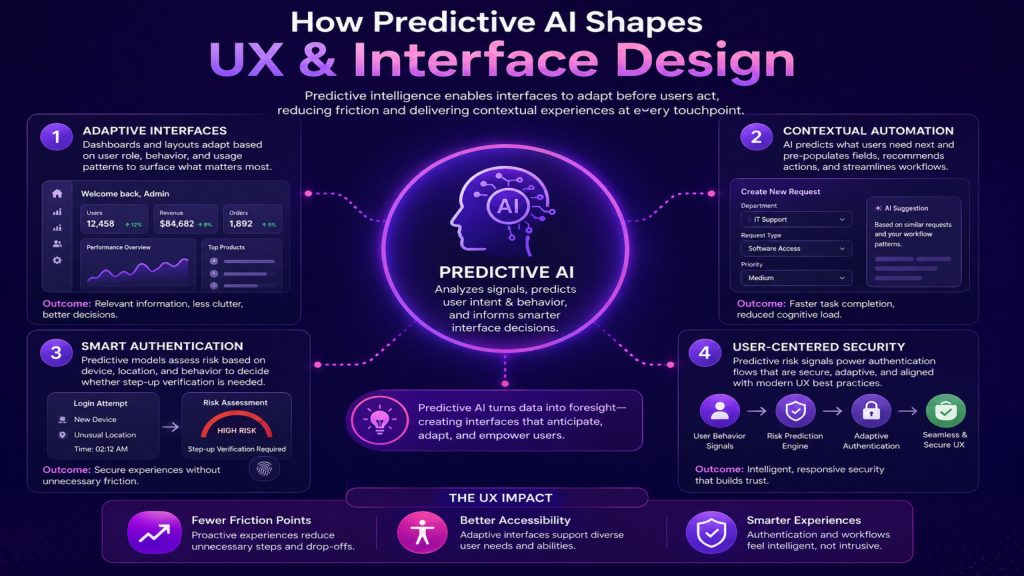
Predictive intelligence enables product interfaces to adapt before users consciously act, reducing friction at every stage of the customer journey through proactive UI behavior and contextual content surfacing.
In product design, behavioral analytics from predictive models feed directly into interaction patterns. When a dashboard adapts its information hierarchy based on a user’s role and usage history, that’s predictive AI informing interface optimization. When an enterprise application pre-populates fields based on workflow patterns, usability testing, and analytics systems work in concert to reduce cognitive load.
Authentication systems also benefit from predictive intelligence. Risk-based authentication assesses device, location, and behavioral signals to determine whether a step-up verification is necessary, a pattern that intersects deeply with secure login design. Teams focused on building authentication flows should understand that How to Create a Modern and Secure Login Page Design directly informs how predictive risk signals translate into responsive, user-centered security experiences.
The UX value here is substantial: fewer false friction points, better accessibility standards compliance, and authentication flows that feel intelligent rather than punitive.
How Generative AI Transforms Product Experience Design
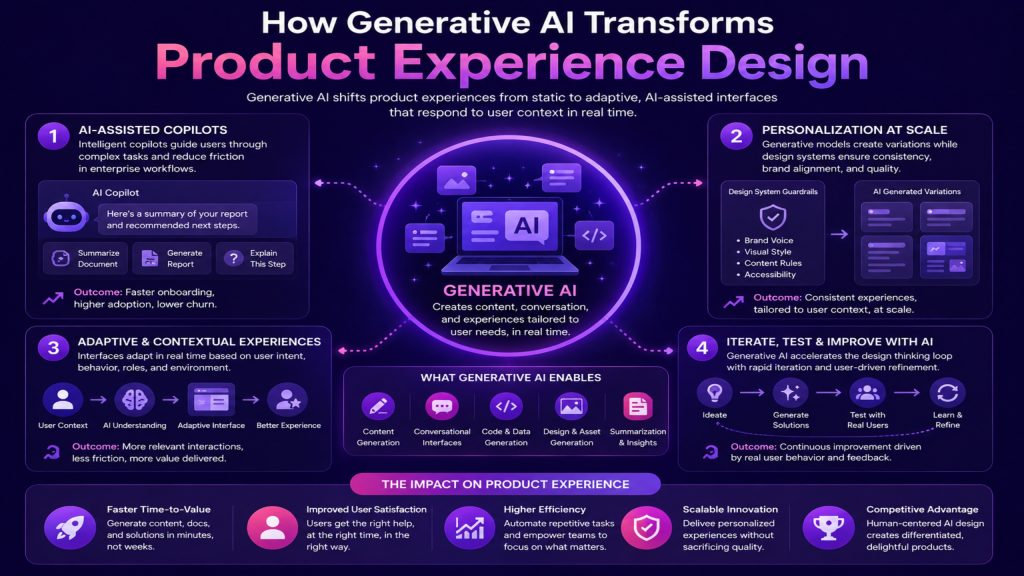
Generative AI fundamentally changes how product teams approach content, design, and user communication, shifting from static systems to adaptive, AI-assisted interfaces that respond to user context in real time.
For enterprise digital products, generative AI introduces a new layer of human-centered innovation. Intelligent copilots within SaaS platforms guide users through complex tasks by generating contextual help, summarizing documentation, or producing structured outputs from unstructured prompts. This reduces time-to-value in enterprise onboarding a friction point that drives early churn.
AI-assisted personalization powered by generative models also enables interface consistency at scale. Rather than handcrafting every content variation, design systems can define guardrails within which generative outputs operate, maintaining visual and tonal coherence across the product experience. This is a scalable design architecture that supports product innovation without sacrificing brand integrity.
Generative AI’s impact on product scalability mirrors principles from design thinking frameworks: iterate fast, test with real users, and refine based on behavioral signals. Teams applying structured product thinking around AI workflows consistently outperform those treating AI as a feature rather than a system.
What Businesses Should Know Before Implementing AI
AI implementation decisions carry architectural, operational, and UX implications. The wrong paradigm for a given use case creates technical debt, misaligned user expectations, and product experiences that feel disconnected from actual user needs.
Before investing in either AI type, enterprise teams should conduct a clear use case mapping exercise:
- If your goal is to forecast demand, risk, behavior, or conversion, predictive AI is the right foundation.
- If your goal is to create or transform content, interfaces, responses, or code, generative AI delivers the most value.
- If your goal is to personalize at scale, the most powerful architectures combine both, using predictive models to determine when and to whom generative outputs are surfaced.
Data quality, governance, and model interpretability also differ significantly between paradigms. Predictive models require clean, labeled datasets and regular retraining cycles. Generative models demand prompt engineering discipline, output evaluation workflows, and guardrails that align with brand and compliance requirements. Enterprise teams building scalable product architecture must account for both sets of operational requirements from day one.
Final Perspective
The predictive AI vs generative AI decision is not binary; it is architectural. Predictive systems give products the intelligence to anticipate, while generative systems give products the capability to create. For enterprise teams and SaaS founders, the highest-value implementations treat both as complementary layers within a unified product experience strategy.
UX designers and product leaders who understand both paradigms are better positioned to define interaction patterns that reduce friction, accelerate value delivery, and scale without degrading usability. The interface is where AI strategy becomes user experience, and that is where the business impact is won or lost.
As AI workflows become embedded in scalable design systems and digital transformation initiatives, the differentiator will not be which AI type a product uses but how thoughtfully it has been designed into the user journey. That is the product design challenge at the center of modern enterprise UX, and it is where F1Studioz helps teams build with purpose, precision, and long-term user value in mind.
Frequently Asked Questions
How does predictive AI differ from generative AI in practical product terms?
Predictive AI analyzes existing data to forecast outcomes, trends, or user behavior, while generative AI creates new content like text, images, code, or recommendations. In product development, predictive AI supports decision-making, whereas generative AI enhances content creation and automation. Both solve different business and user experience needs.
Which type of AI is better for improving SaaS user experience?
Predictive AI is better for improving SaaS user experience through personalization, recommendations, churn prediction, and workflow optimization. Generative AI, however, improves user interaction with chatbots, content generation, and AI assistants. The better choice depends on the product’s primary user goals.
Can enterprise products use both predictive and generative AI together?
Yes, enterprise products can combine predictive and generative AI to create smarter workflows and better automation. Predictive AI can identify user intent or risks, while generative AI can respond with personalized content or actions. Many modern SaaS platforms already use both together for better efficiency.
How does AI affect the login and authentication user experience?
AI improves login and authentication experiences through biometric verification, fraud detection, adaptive authentication, and faster identity checks. It helps reduce friction for genuine users while identifying suspicious login attempts in real time. This creates a more secure and user-friendly authentication process.
What should product teams evaluate before choosing an AI implementation approach?
Product teams should evaluate business goals, data quality, user privacy, implementation cost, scalability, and expected ROI before selecting an AI approach. They should also consider whether the use case requires prediction, content generation, automation, or all three together. A clear understanding of user needs helps choose the right AI strategy.