
UX design enhances customer experience in telecom platforms by simplifying self-service journeys, creating intuitive billing and recharge flows, and enabling faster issue resolution through well-structured interfaces. It ensures omnichannel consistency across mobile apps, web portals, and kiosks, reduces customer churn through improved usability, and directly improves satisfaction metrics by making complex telecom services more accessible and transparent.
Telecom platforms handle millions of daily transactions, from plan changes to troubleshooting network issues. The quality of these digital interactions determines whether customers stay loyal or switch providers. In an industry where products are increasingly commoditized, user experience has become the primary differentiator. Telecom companies that invest in strategic UX design see measurable improvements in customer retention, operational efficiency, and digital channel adoption.
Why UX Design is Critical for Customer Experience in Telecom
UX design directly impacts customer satisfaction, churn reduction, and service adoption in telecom platforms. Well-designed experiences increase digital channel usage, reduce support costs, and improve operational efficiency by enabling customers to complete tasks independently without human intervention.
According to research from the Nielsen Norman Group, improving user experience can increase conversion rates by up to 400% while significantly reducing customer support inquiries. In telecom, where margins are thin and customer acquisition costs are high, these improvements translate directly to profitability.
The stakes are particularly high in telecom because poor UX often leads to immediate competitor research. When customers struggle to understand their bills, modify their plans, or resolve service issues, frustration builds quickly. Unlike other industries where switching costs are minimal, telecom customers face contract obligations and device dependencies. This creates a pressure cooker effect where accumulated UX friction eventually leads to mass exodus during contract renewal periods.
Digital transformation teams in telecom recognize that UX is not simply about aesthetics. It fundamentally determines whether customers can complete essential tasks. When telecom companies evaluate UX partners, they often begin by understanding how SaaS, fintech, and startup companies in India choose the right UI UX design agency, since this helps establish a structured evaluation framework that applies across complex platform environments.
Modern telecom platforms must serve diverse user segments simultaneously. Prepaid users need quick recharge flows. Enterprise customers require detailed usage analytics. Senior citizens may need larger touch targets and simplified navigation. This complexity makes UX design essential rather than optional.
Key UX Challenges in Telecom Platforms

Telecom platforms face unique UX challenges that differ significantly from other digital products. These challenges stem from regulatory requirements, legacy systems integration, diverse user bases, and the inherent complexity of telecom services themselves.
One fundamental challenge is plan selection complexity. Customers face dozens of plan options with varying data limits, speed throttling policies, roaming conditions, and bundled services. Without guided UX flows, users experience decision fatigue and often select suboptimal plans or abandon the process entirely.
Billing interfaces present another major pain point. Telecom bills include usage charges, plan fees, taxes, surcharges, device installments, and promotional credits. When billing UX fails to clearly communicate these elements, customers flood support channels with billing inquiries, increasing operational costs while damaging trust.
Fragmented customer journeys create consistency problems across channels. A customer might start a plan change on the mobile app, get interrupted, then try to continue on the website only to find their progress lost. This lack of omnichannel continuity forces customers to restart tasks, creating abandonment and frustration.
Poor onboarding flows particularly impact prepaid segments and new customers. Many telecom apps assume users already understand concepts like data rollover, network selection, or APN settings. When onboarding skips education and jumps straight to feature overload, customers struggle to extract value from the platform.
Lack of personalization means all users see identical interfaces regardless of their usage patterns, device capabilities, or service plans. A data-heavy user needs different dashboard insights than a voice-focused customer, yet most telecom platforms offer one-size-fits-all experiences.
Common Telecom UX Challenges and Solutions
| Challenge | Impact on Users | UX Solution |
| Complex plan selection | Decision fatigue, choice paralysis | Guided plan selectors with comparison tools |
| Billing confusion | Increased support calls, distrust | Simplified billing UX with visual breakdowns |
| Fragmented journeys | Task abandonment, frustration | Unified cross-channel UX flows |
| Poor onboarding | Low feature adoption, confusion | Progressive onboarding with contextual education |
| Generic interfaces | Missed personalization opportunities | Usage-based dashboard customization |
| Technical jargon | Comprehension barriers | Plain language content strategy |
| Hidden usage limits | Bill shock, complaints | Proactive alerts and transparent limit displays |
Many teams review UI UX design cost in India for SaaS, fintech, and startup products to align UX investment with expected business outcomes, recognizing that telecom UX improvements deliver measurable ROI through reduced support costs and increased digital adoption.
How UX Design Improves Telecom Customer Experience
Effective UX design transforms telecom platforms from confusing service interfaces into empowering self-service tools. These improvements manifest across multiple customer touchpoints and journey stages.
Simplified recharge and billing journeys represent immediate impact areas. UX improvements here include saved payment methods with biometric authentication, one-tap recharge for favorite amounts, and visual bill breakdowns that replace line-item tables with categorized spending insights. Progressive telecom platforms now show bill predictions mid-cycle, allowing customers to adjust usage before overage charges occur.
Intuitive mobile apps and self-service portals reduce dependency on call centers and retail visits. Well-designed portals enable customers to upgrade plans, add family members, troubleshoot connectivity issues, and manage device installments without human assistance. This shift improves customer satisfaction (users get instant resolution) while reducing operational costs (fewer support interactions per customer).
Faster issue resolution flows integrate diagnostics directly into support interfaces. Instead of generic contact forms, modern telecom UX includes guided troubleshooting that tests connectivity, checks for outages, resets network settings, and escalates to human agents only when automated solutions fail. This tiered approach resolves simple issues instantly while providing agents with diagnostic context for complex cases.
Proactive notifications and alerts prevent problems before they escalate. UX design determines which notifications deserve interruption versus quiet inbox delivery. Effective telecom platforms alert users about approaching data limits, unusual charges, payment failures, and network maintenance through appropriate channels (push for urgent, email for informational) with clear action paths.
Omnichannel experience consistency ensures customers receive uniform service quality regardless of touchpoint. This requires design systems that maintain visual consistency, data synchronization that preserves context across devices, and interaction patterns that feel familiar whether customers use mobile apps, responsive websites, USSD codes, or physical kiosks.
Product teams also explore how UX design improves conversion, retention, and product adoption in SaaS, since telecom platforms face similar challenges in user engagement and feature adoption. The principles that drive SaaS success (clear value propositions, low-friction onboarding, habit-forming interaction patterns) apply equally to telecom digital products.
Real product design thinking focuses on jobs to be done rather than feature checklists. Customers don’t want billing interfaces; they want to understand spending and avoid surprises. They don’t want network settings; they want reliable connectivity. UX design translates technical capabilities into outcome-focused experiences.
Key UX Principles for Telecom Platforms
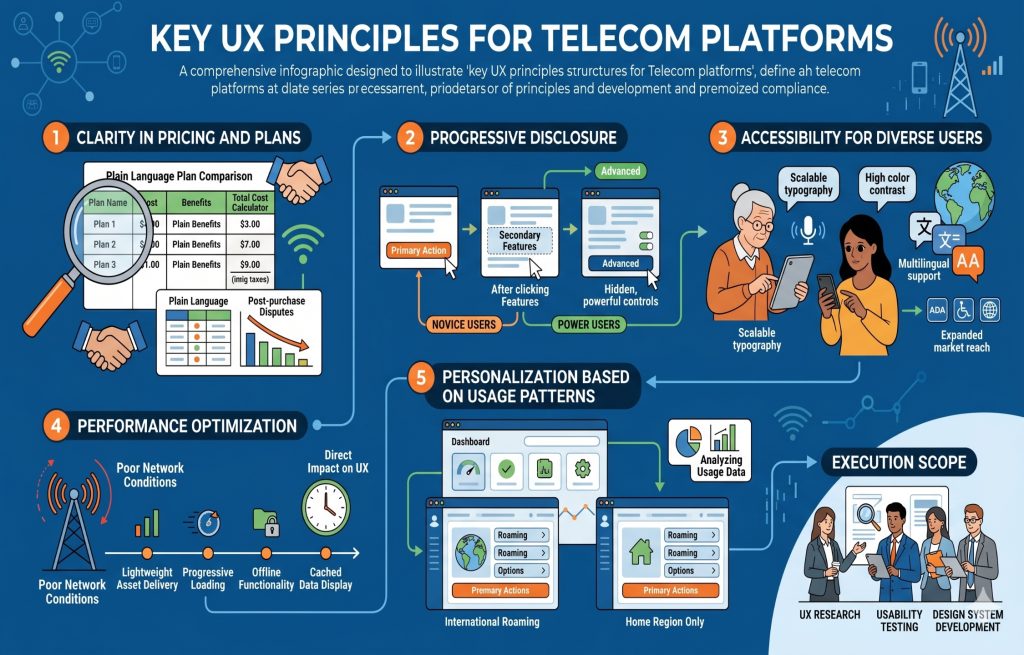
Telecom platforms require specific UX principles that address industry-specific complexity while maintaining usability standards. These principles guide design decisions across product development cycles.
Clarity in pricing and plan forms the foundation of telecom UX trust. This principle demands transparent presentation of costs, limits, and conditions without hiding details in fine print. Effective implementations use comparison tables, plain language explanations, and total cost calculators that account for taxes and fees. When users understand exactly what they’re purchasing, plan selection confidence increases, and post-purchase disputes decrease.
Progressive disclosure manages complexity for diverse user segments. Rather than overwhelming users with every option simultaneously, well-designed telecom interfaces reveal information in layers. Initial views show essential controls and primary actions. Secondary features appear through clear navigation. Advanced settings remain accessible but don’t clutter mainstream workflows. This approach serves novice users (who need simplicity) and power users (who need control) through the same interface.
Accessibility for diverse users acknowledges that telecom services reach across age groups, languages, literacy levels, and physical abilities. UX implementations must include sufficient color contrast, scalable typography, voice control compatibility, multilingual support, and simplified modes for users with cognitive differences. Regulatory requirements increasingly mandate accessibility, but business value comes from expanded market reach and improved satisfaction across all segments.
Performance optimization directly impacts telecom UX because users often access these platforms under poor network conditions. Design decisions like progressive loading, offline functionality, cached data displays, and lightweight asset delivery ensure usability even when connectivity fluctuates. Telecom apps that fail to account for network variability create ironic situations where customers experiencing connectivity problems cannot access the very tools designed to help diagnose those problems.
Personalization based on usage patterns transforms generic platforms into tailored experiences. Modern telecom UX analyzes usage data to customize dashboard displays, recommend relevant plans, surface applicable add-ons, and adjust interface complexity to match user sophistication. A customer who consistently uses international roaming sees different primary actions than someone who never leaves their home region.
To understand execution scope, decision makers often review what a UI UX design agency in India actually does for SaaS and tech products, including UX research, usability testing, and design system development. These same capabilities apply to telecom platform design, where research uncovers segment-specific pain points and testing validates solutions before full deployment.
How to Evaluate UX Improvements in Telecom Platforms
Measuring UX impact requires connecting design changes to business outcomes through specific metrics. Telecom companies need frameworks that demonstrate return on UX investment to justify continued design focus.
Task completion rates measure how successfully users accomplish primary goals like plan changes, recharges, or trouble ticket submissions. Baseline measurements before UX improvements establish comparison points. Post-implementation tracking reveals whether design changes actually improved success rates. Sophisticated approaches segment completion rates by user demographics, device types, and journey entry points to identify remaining friction areas.
Churn reduction represents the ultimate telecom metric, directly connecting UX quality to revenue retention. Analyzing churn cohorts by digital engagement level typically reveals that customers who successfully adopt self-service tools exhibit lower churn rates. UX improvements that increase digital adoption, therefore indirectly reduce churn. Advanced attribution modeling can isolate UX impact from other retention factors like pricing and network quality.
Customer satisfaction scores (CSAT, NPS) provide sentiment indicators that complement behavioral metrics. Surveying customers immediately after key interactions (post-recharge, post-support contact, post-plan change) captures experience quality while context remains fresh. Tracking score trends alongside UX releases helps validate which improvements meaningfully impact satisfaction versus which generate minimal perception change.
Support ticket reduction translates UX improvements directly into operational cost savings. When self-service portals successfully enable customers to complete tasks independently, support contact volume decreases. Categorizing tickets by type reveals which UX improvements deliver maximum deflection. For example, improving bill explanation UX should reduce billing inquiry tickets specifically.
Feature adoption rates indicate whether new capabilities actually deliver user value. Telecom platforms frequently add features (usage alerts, speed tests, family controls) that remain undiscovered or unused. Measuring adoption through active usage rather than simple availability reveals whether UX successfully communicates value and enables access. Low adoption despite high potential value signals UX problems in discoverability or usability.
Budget considerations also play a role. Many teams review UI UX design cost in India for SaaS, fintech, and startup products to align UX investment with expected business outcomes, recognizing that measurement frameworks justify initial investment and guide ongoing optimization priorities.
Frequently Asked Questions
What makes telecom UX different from other digital products?
Telecom UX must handle extreme complexity (billing, plans, network technical details) while serving highly diverse user segments from tech-savvy digital natives to elderly users with basic digital literacy. Regulatory requirements, legacy system constraints, and real-time service dependencies create unique design challenges absent in most digital products.
How does UX design reduce customer churn in telecom?
UX design reduces churn by removing friction from essential customer tasks, improving billing transparency, enabling effective self-service, and creating positive interactions that build loyalty. When customers can easily manage their services and understand their spending, satisfaction increases and switching motivation decreases significantly.
What ROI can telecom companies expect from UX investment?
Telecom companies typically see 200% to 400% ROI from strategic UX investment through reduced support costs, increased digital channel adoption, improved plan upgrade conversion, and measurable churn reduction. Specific returns vary based on current experience quality and implementation scope across customer touchpoints.
Which telecom platform areas benefit most from UX improvement?
Billing and recharge experiences, plan selection flows, customer onboarding, and troubleshooting interfaces deliver the highest UX improvement impact. These high-frequency touchpoints directly affect customer satisfaction and represent major support cost drivers when poorly designed, making them priority optimization targets.
How long does it take to see results from telecom UX improvements?
Initial metrics like task completion rates and customer satisfaction scores show improvement within weeks of implementation. Churn reduction and significant support cost savings typically manifest over three to six months as improved experiences accumulate across the customer base and renewal cycles progress.
Conclusion
Telecom platforms face distinctive UX challenges stemming from service complexity, diverse user populations, regulatory constraints, and legacy technology integration. These challenges manifest as confusing billing interfaces, overwhelming plan options, fragmented omnichannel experiences, and insufficient self-service capabilities that drive customers toward frustration and eventual churn.
Strategic UX design addresses these challenges through clarity-focused information architecture, progressive disclosure that manages complexity, accessibility that serves all user segments, and personalization that adapts interfaces to individual usage patterns. When implemented effectively, these UX improvements transform customer experience from a source of friction into a competitive differentiator.
The business impact extends beyond satisfaction metrics. Measurable improvements in task completion rates, support cost reduction, digital adoption, and churn prevention demonstrate clear ROI from UX investment. As telecom services become increasingly commoditized, how UX design enhances customer experience in telecom platforms determines which providers retain loyalty and which lose customers to competitors offering superior digital experiences.
For telecom product managers, digital transformation teams, and CX leaders, prioritizing UX design represents strategic necessity rather than optional enhancement. The platforms that win customer loyalty will be those that make complex services feel simple, empower self-service without requiring support contact, and create experiences customers actually enjoy rather than merely tolerate.